Pack Your Bags and Your Stash: The States Most Likely to Go Green Next
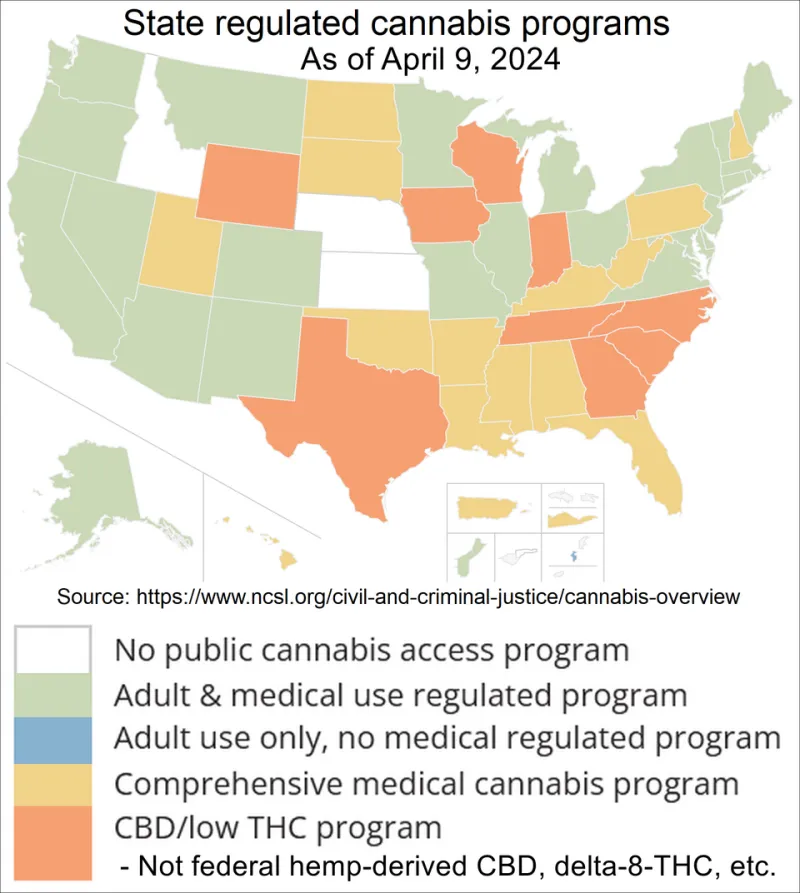
Photo: National Conference of State Legislatures, Public domain, via Wikimedia Commons
Let's be real — living in a state where cannabis is still illegal in 2025 is starting to feel like being the last person in your friend group without a streaming subscription. Technically survivable, but increasingly inconvenient and kind of absurd. With 24 states plus Washington D.C. having legalized recreational cannabis and the majority of Americans consistently polling in favor of legalization, the dominoes are still falling. The question is: which ones are next, and should you be there when it happens?
The Polling Tells a Story (If You Know How to Read It)
Public opinion is the clearest early indicator of where legalization is headed. When support in a state consistently clears 55–60% in independent polling, legislators start paying attention — especially in election years. Right now, a handful of states are sitting in that sweet spot.
Pennsylvania is arguably the most watched state on this list. With a Democratic governor in Josh Shapiro who has openly supported legalization, a growing coalition in the legislature, and a population that has watched neighboring New Jersey and New York go legal, the pressure is mounting. A 2024 Franklin & Marshall poll found that roughly 60% of Pennsylvanians support adult-use legalization. The state already has a robust medical program, which historically serves as a proving ground that accelerates the path to full legalization. If Pennsylvania crosses over, it would be one of the most significant dominoes to fall yet — a large, politically purple state with a massive population and serious economic weight.
Minnesota already made it happen in 2023, but neighboring Wisconsin is still stuck. That said, Wisconsin's polling has shifted dramatically over the past five years, with support now hovering around 60% according to Marquette University polling. The state's governor Tony Evers has pushed legalization bills multiple times, only to watch them stall in a Republican-controlled legislature. But legislative maps are changing, and pressure from bordering legal states is intensifying. Wisconsin feels like a state that's one election cycle away from flipping the script.
Hawaii is another one to watch. The islands have a deeply entrenched medical cannabis culture and a legislature that has come closer to passing adult-use bills than most people realize. Geography actually works in Hawaii's favor here — there's no neighboring legal state drawing away tax revenue, which removes one of the classic economic pressure arguments. Legalization there would likely look different from mainland states, potentially with tighter regulations around tourism, but movement is real.
What Early States Actually Learned
Colorado and Washington went first back in 2012, and the rest of the legal states have been quietly downloading their learnings ever since. Some lessons are obvious in hindsight but took years to figure out on the ground.
Tax structure matters enormously. States that front-loaded taxes at the cultivation level — before the product even hit a shelf — created pricing problems that propped up the illicit market. California learned this painfully. Newer states like New Jersey and New York have tried to build more flexible tax frameworks, though they've had their own rollout headaches.
Equity provisions need teeth, not just language. Early legal states wrote equity programs into their laws but often failed to fund them adequately or streamline licensing for communities most harmed by the War on Drugs. States coming online now are being pushed hard by advocates to do better from day one — and some are listening.
Regulatory speed is a competitive advantage. The longer a state takes to stand up its retail infrastructure after voters approve legalization, the longer the illicit market holds its ground. Michigan moved relatively quickly and saw strong market performance as a result. New York's notoriously slow rollout is a cautionary tale that every incoming state is studying.
Should You Actually Move for Weed?
Okay, let's get practical. If you're a medical patient in a state with no legal access — or a recreational consumer who's genuinely tired of navigating gray markets — the idea of relocating to a legal state probably crosses your mind more than you'd admit.
Here's the honest framework for thinking about it:
If you're a medical patient, the calculus is different than for recreational consumers. Access to specific formulations, reliable supply, and legal protection around your medicine are serious quality-of-life issues. If you're in a state with no medical program or an extremely restrictive one, and you're considering a move for other life reasons anyway, leaning toward a legal state makes a lot of sense. States like Colorado, Michigan, and Illinois have mature medical markets with a wide range of products.
If you're a recreational consumer, moving solely for legal weed is probably not the move — but if you're weighing two otherwise comparable options, legal status is a completely legitimate factor. Think about it this way: you'd consider a state's tax rate, weather, job market, and cost of living. Why wouldn't you consider whether you can legally enjoy something that tens of millions of Americans use regularly?
If you're holding out, and you're in a state that looks close — Pennsylvania, Wisconsin, Hawaii, maybe even Georgia or North Carolina where grassroots momentum is quietly building — you might be closer to relief than you think. Waiting it out has its own logic, especially if your life is rooted where you are.
The Regional Domino Effect Is Real
One of the most underappreciated forces in cannabis legalization is geographic pressure. When a state goes legal, its neighbors immediately start watching tax revenue flow across the border. New Jersey's legalization was accelerated in part by watching Pennsylvania residents drive to dispensaries. Ohio going legal in 2023 put immediate pressure on Indiana, Kentucky, and West Virginia — all of which are now seeing increased legislative activity.
The South is the last major holdout region, but even there, the cracks are showing. Florida's ballot initiative landscape means a well-funded push could put adult-use legalization before voters sooner than the legislature would ever allow. Arkansas, despite rejecting a 2022 ballot measure, saw a closer result than many expected. The South isn't a monolith, and assuming it will hold the line indefinitely is probably wishful thinking for prohibitionists.
The Bottom Line
The map is changing, and it's changing faster than anyone predicted when Colorado and Washington first went legal over a decade ago. Whether you're planning your next move or just watching the politics play out from your couch, one thing is clear: the question is no longer if the rest of the country legalizes — it's when, and how well. Free the weed, state by state, until there's nowhere left to hide from common sense.